I've been working on cars for almost a year now and I've learned a ton along the way. Cars aren't as complicated as most people (and mechanics) make them out to be. In this article I will attempt to break down the vital systems of the car and explain their functions.
1. Engine
Everyone knows an engine powers a car. You can have a four cylinder a V8 or, if you have 1.2 million dollars, a W16. Lets start by seeing what these numbers and letters mean. If there isn't a letter before the number of cylinders (4 cylinder or straight six cylinder) it means that the engine is one big rectangle with all the cylinders next to each other. If there is a letter, the letter is the shape of the engine. A V8 engine has a V shape to it, hence V8. Same for the W16 in the Bugatti Veyron, W16, therefore, a W shaped engine. So how does it work? I won't go into specifics of the 4 stroke engine cycle but I'll make it so the average joe can understand what I mean. Each cylinder has: 1 or multiple intake valves, 1 fuel injector, 1 or more exhaust valves, 1 piston and 1 spark plug. The engine works by combining air from the intake valves and fuel from the fuel injector in the cylinder and then igniting the mixture with a spark from the spark plug. This results in a highly exothermic reaction which forces the piston downwards and turns the crankshaft. Then the exhaust valves open to release the by-products of combustion and the cycle repeats. A crankshaft is basically a hunk of metal at the bottom on the engine that is attached to the bottom of all the pistons which converts the up and down motion of the pistons to circular motion (the kind the wheels make when you drive). The combined force of all the pistons working in a perfectly timed fashion provides a tremendous amount of power that enables you to move with speed. Here is video with animation of how an engine works in more detail. It also explains the 4 stroke engine cycle quite well.
2. Transmission
 Despite the fact the crankshaft turns in a circular motion the engine doesn't send its raw power to the wheels, it sends it to the transmission to manage it more effectively. There are two main types of transmissions. Automatics and manuals. I will discuss automatics as manuals work the same way except the driver manually changes the gears instead of a computer doing so. The spinning crankshaft is attached to what is a really big gear called a flex plate (flywheel on manual transmissions) pictured on the right. This gear is attached to the transmission which adjusts the gear ratios of the engine to the gear of the transmission. It then sends the power from the transmission gear to the axle which in turn moves the wheels. First gear has a high gear ratio to allow the driver to accelerate from a stop. It tends to be around a 3 to 1 ratio, meaning that for every 3 turns of the engine 1st gear moves one turn. It works the same way as a bike, when you gear down going up a hill pedaling is easier but you don't move as fast. That's because of the high gear ratio on your bike's first gear. The gear ratios slowly get lower and lower to around 0.7 to 1. So for every 7 tenths of a turn of the engine the wheels move one full turn, this allows cars to go at high speeds of around 70 miles an hour without wasting a lot of gas and revving the engine too high. Gearing up on your bike makes pedaling tougher but allows you to go faster and the same concept is applied when a car is in a high gear. So how does the car shift gears? The cars on-board computer detects the engine's speed along with the position of the throttle (how hard you're stepping on the gas) and based on that either allows the car to stay in gear for more acceleration or gears up to get a high speed without quick acceleration (to save gas).
3. Battery and Electrical Stuff
Your car has a battery but how come it never runs out like your phone battery does? How come you never have to charge it? Whats the battery for? The battery powers all electrical components of the car, cabin lights, headlights, taillights, dashboard lights, radio, clock, the fan (NOT the a/c but just the fan) and the starter. The starter is a simple motor attached to the battery and the flex plate we discussed earlier. When you turn the key the starter physically turns the engine over a few times while the spark plugs and fuel injector fires fuel into the engine to get the whole cycle going, once that starts you let go of the key and your car is on. Now how does the battery stay charged? Remember our lovely crankshaft? One end was bolted to the flex plate but what about the other end? The other end is attached to a pulley which has a belt on it which turns accessories. One of this accessories is called an alternator. If you remember how a motor works from physics class an alternator is simply a reverse motor, you spin the coils of wire around the magnetic to generate electricity instead of vice-versa. The belt on the crankshaft is attached to a pulley on the alternator and when the car is on and the crankshaft is spinning the alternator is also spinning, generating electricity for the battery and keeping it fresh for the next time you want to start your car.
4. Suspension
How come some cars can hit a pothole and feel nothing but others bounce up and down miles after the pothole was hit? There are three main parts of your suspension: shocks, springs and joints. Shocks are cylindrical with gas in them and and a rod that the spring sits over. This combination is behind each wheel of the car and is bolted to the frame. Basically when the road surface isn't smooth the spring expands or compresses depending on the type of deformity you hit; if its a bump it compresses if its a pothole it expands. In physics we learn that when springs are stretched, compressed and released the spring oscillates back and forth until it runs out of energy. (Simple harmonic motion at work!) This is where the shock comes into play, the shock expands/compresses with the spring but the gas and the rod work to stop the back and forth movement of the spring when the spring returns to its original position, this keeps your car from bouncing every time you hit a bump. A good test to see if your shocks are good is by going to each corner/wheel of your car and pushing down hard on the body so the car goes down and watch it come up. If it comes up once and stops your shocks are good, if it bounces a bit, the shocks are wearing out, and if they bounce like a monkey on a pogo stick then you need new shocks. Then come the joints. Joints hold various suspension parts together while allowing them to move when needed. When the bearings inside the joints wear out the joints move when they're not supposed to, this is known as play. Bad joints can be deadly as they can break and separate car from the wheel resulting in a nasty accident. A good way to check for play is to jack up the car, inspect the wheel and shake it by hand. If it moves and wiggles, you have some bad joints. Also a car shaking at highway speeds could also be indicative of bad joints.
5. Cooling System
So I hope you guys enjoyed or at least learned something you didn't know before. A car is a lovely example of the wonders of applied physics and chemistry, and the fact prototypes were made in the late 1800's is astonishing as well. Or maybe it isn't and I'm just either a nerd, either way I love it. As always thanks for reading and if you have any car questions feel free to drop a comment!
1. Engine
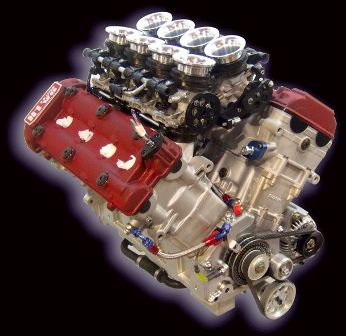 |
| The V shape is formed from the bottom of the engine to the red covers |
2. Transmission
3. Battery and Electrical Stuff
 |
| Alternator |
 |
| Shock and spring assembly |
How come some cars can hit a pothole and feel nothing but others bounce up and down miles after the pothole was hit? There are three main parts of your suspension: shocks, springs and joints. Shocks are cylindrical with gas in them and and a rod that the spring sits over. This combination is behind each wheel of the car and is bolted to the frame. Basically when the road surface isn't smooth the spring expands or compresses depending on the type of deformity you hit; if its a bump it compresses if its a pothole it expands. In physics we learn that when springs are stretched, compressed and released the spring oscillates back and forth until it runs out of energy. (Simple harmonic motion at work!) This is where the shock comes into play, the shock expands/compresses with the spring but the gas and the rod work to stop the back and forth movement of the spring when the spring returns to its original position, this keeps your car from bouncing every time you hit a bump. A good test to see if your shocks are good is by going to each corner/wheel of your car and pushing down hard on the body so the car goes down and watch it come up. If it comes up once and stops your shocks are good, if it bounces a bit, the shocks are wearing out, and if they bounce like a monkey on a pogo stick then you need new shocks. Then come the joints. Joints hold various suspension parts together while allowing them to move when needed. When the bearings inside the joints wear out the joints move when they're not supposed to, this is known as play. Bad joints can be deadly as they can break and separate car from the wheel resulting in a nasty accident. A good way to check for play is to jack up the car, inspect the wheel and shake it by hand. If it moves and wiggles, you have some bad joints. Also a car shaking at highway speeds could also be indicative of bad joints.
 |
| There are plenty of joints to worry about in a suspension system |
Burning all that fuel in the engine causes a lot of heat and as such the engine must be properly cooled. The 4 parts of the cooling system are the coolant, heater core, water pump and radiator. Inside the engine there are passages for coolant to travel through and holes for them enter and exit out of. Coolant is nothing more than enhanced water. Ethylene glycol is added to water to increase the boiling point and lower the freezing point of the water. The cooling system works by taking heat from the engine, transferring it through the coolant, and running it through the radiator to dissipate the heat with fans and the aluminum fins of the radiator. The cooled coolant goes back into the engine and the cycle repeats. The water-pump is driven by the timing belt and simply pumps coolant through the system. The heater core is another stop along the engine - radiator trail and is another mini radiator that draws heat from the coolant and allow the heat to be blown into the cabin. This is how the heater in your car works. Cooling systems are easy to maintain but failures can catastrophic to the engine so its maintenance is vital.
 |
| Large racing rotor with a 4 piston caliper, overkill for most drivers but looks cool |
6. Brakes
This is the last topic I'll cover for today. Stopping a car is just as important as making it move. Brakes are actually really simple devices. The parts of a brake system are the brake fluid, hydraulic hoses, calipers, rotors, and pads. The rotor is a shiny disk the is attached right behind the wheel. It is the part the brakes push on to create friction to stop the car. The caliper sits on the rotor as shown in the image and its bolted on by a bracket and houses the two brake pads (friction material to rub against the rotor), one for each side of the rotor, and has 1 or multiple pistons. When you push on the brake pedal you are pushing a large diameter piston which forces brake fluid through the hoses and into the smaller diameter end of the piston. This difference between diameters multiples the force tremendously and allows the small force of your foot on the pedal to translate to a large force of the brake piston(s) pushing the pads against the rotor until the car stops. During races this can cause a tremendous amount of heat and make the rotors look really cool. And being the awesome blogger I am I shall upload a picture for you guys to see it. Enjoy!
 |
| That is an actual rotor doing some hard core braking. |
P.S. My next article will be in two days following the Redskins - Bears preseason match up.

No comments:
Post a Comment